
22/01/07
주어진 문자열에 다른 주어진 문자를 제거하고 역순화 시킨 문자열 만드는 함수
ex)abcabc b (입력) → caca (출력)
조건
- 함수명 : revsqueeze
- 포인터만 사용할 것(배열x)
1
2
3
4
5
6
7
8
9
10
11
12
13
14
15
16
17
18
19
20
21
22
23
24
25
26
27
28
29
30
31
32
33
34
35
#include <stdio.h>
#include <string.h> // for strlen()
#include <stdlib.h> // for malloc()

// 함수 선언

int main() {

    // 변수 선언

    while ((s[i++] = getchar()) != '\n');

    s[i--] = '\0';

    c = getchar();

    result = revsqueeze(s, c);

    printf("%s\n", result);

    return 0;
}

// 함수 정의
{
    // 변수 선언

    len = strlen(ps);

    temp = (char *)malloc(len + 1); // 결과 문자열 저장 공간 생성

    // 알고리즘

    return temp;
}
소스 코드
1
2
3
4
5
6
7
8
9
10
11
12
13
14
15
16
17
18
19
20
21
22
23
24
25
26
27
28
29
30
31
32
33
34
35
36
37
38
39
40
41
42
43
44
45
#include <stdio.h>
#include <string.h>
#include <stdlib.h>

char *revsqueeze(char*, char); // 1. 함수 선언

int main() {

    int i=0;
    char s[80], c, *result;

    while ((s[i++] = getchar()) != '\n');

    s[i--] = '\0';

    c = getchar();

    result = revsqueeze(s, c); // 2. 포인터 변수 = 포인터 함수

    printf("%s\n", result);

    return 0;
}

char *revsqueeze(char *ps, char c)
{
    int i, j=0, len;
    char *temp;

    len = strlen(ps); // 포인터의 길이만큼 len 설정

    temp = (char *)malloc(len + 1); // 포인터 길이만큼 메모리 확보

    ps = ps + len -1; // 3. 포인터의 위치를 포인터의 끝으로 변경(문제 조건을 위한 설정)

    for(i=0; i<len; i++) { // len(포인터의 길이)만큼 for문 실행
        if (*ps != c) // 4. 포인터가 가리키는 값이 c와 같지 않으면
            *(temp + j++) = *ps--; // temp에 c 추가 후 포인터 위치 변화
        else
            ps--; // 포인터와 c가 같으면 건너뛰기
    }
    *(temp - j) = '\0';

    return temp;
}
main()의 배열(s)을 call by reference로 사용하기 위해
*사용포인터 함수 결과를 저장하기 위해 포인터 변수 사용
- ps = ps[0] >> ps[0]을 ps 마지막으로 위치이동 = ps + len >> ps[len] >> ps의 마지막 위치 = len -1 >> ps + (len - 1)
- ex)
- s = “hello”
- s[0] = h, s[1] = e, s[2] = l, s[3] = l, s[4] = o
- strlen(s) = 5
- s[strlen(s)] = s[5] = ‘\0’(NULL)
- s[strlen(s) - 1] = s[4] = ‘o’
- ex)
- *ps != c
- *ps = *ps가 참조하는 값
- ex)
- s[] = {1,2};
- *ps = s;
- *ps ≡ *(ps + 0) ≡ *ps[0] ≡ 1
- != 아니다!
1
2
3
int n = 3;
if (n != 2) printf("3이 아니다!");
else printf("3이다!");
결과 : 3이다! - if ( *ps != c ) : ps가 참조하는 값이 c가 아니라면
실행 순서
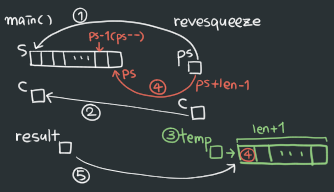
- abcab a (입력)
- s = {‘a’, ‘c’, ‘c’, ‘a’, ‘b’}
- c = ‘a’
- revesqueeze(s, c)
- len = strlen(s) = 5
- temp = (char *)malloc(len + 1) >> temp에 6바이트 메모리 확보
- ps = ps[4]
- for j = 0, 1, 2, 3, 4
j값 i값 *ps값 *ps != c 결과 *(temp+i)값 0 0 b T(b!=a) 0 b 1 a 1 1 a F(a!=a) c 2 1 c T(c!=a) 1 c 2 c 3 2 c T(c!=a) 2 c 3 a 4 3 a F(a!=a) NULL 5 - *(temp + 3) = ‘\0’
- *temp → {‘b’, ‘c’, ‘c’}
- return temp
- main() result = {‘b’, ‘c’, ‘c’}
- printf(“%s\n”, result);
결과
- bcc
Comments powered by Disqus.